Kigi (kigi) 🌘

🕸️ The world's first CLI with built-in Graph Engineering

/graph turns one objective into a dependency graph of autonomous, self-verifying agent loops — planned, parallelized, adversarially verified, and merged back, end to end.

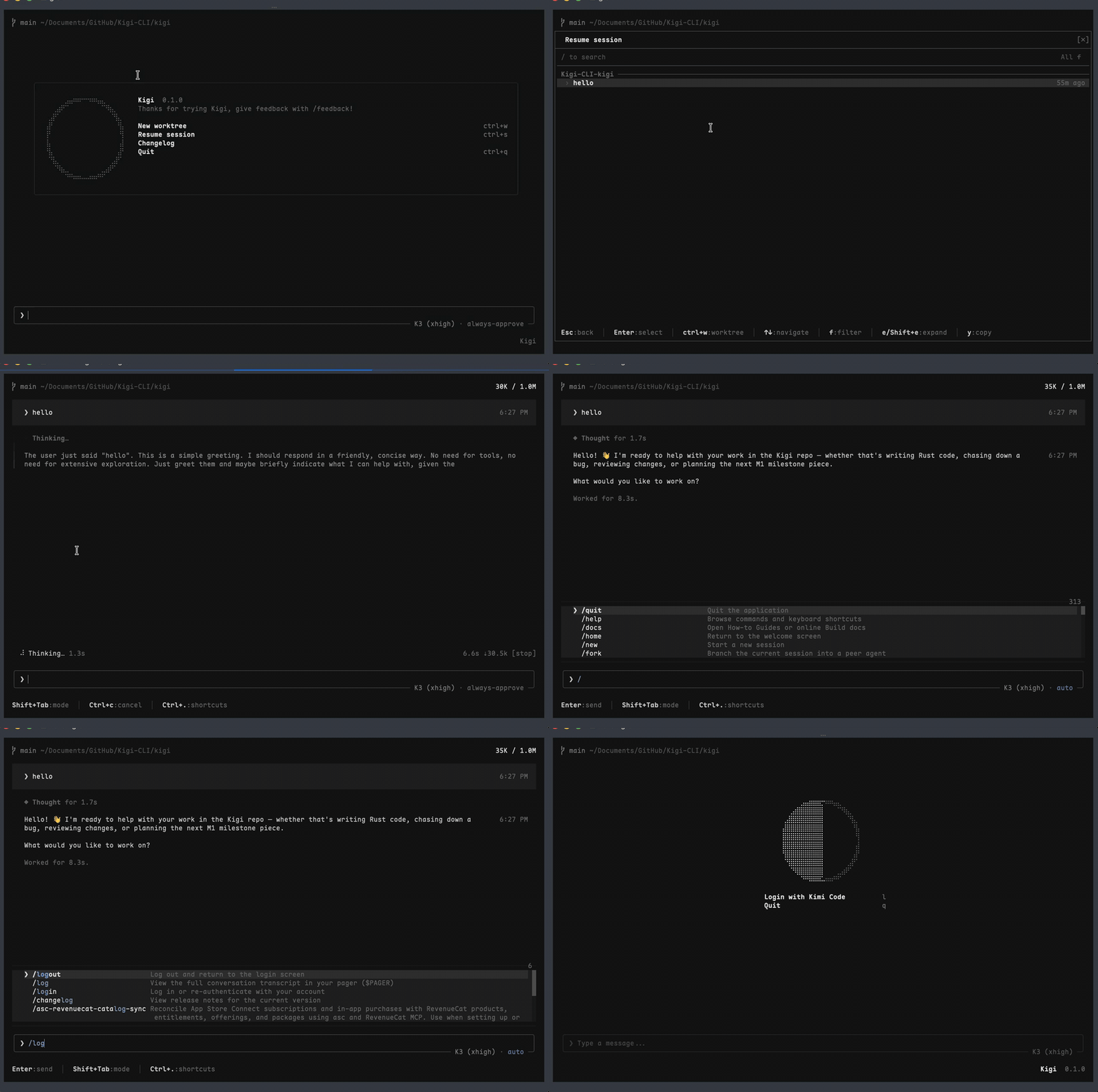
**Kigi** is an unofficial Kimi Code CLI community build — a terminal-based AI coding agent re-targeted at the Kimi Code subscription API and the Moonshot open platform, built on the Apache-2.0 sources of [xai-org/grok-build](https://github.com/xai-org/grok-build). It runs as a full-screen TUI that understands your codebase, edits files, executes shell commands, searches the web, and manages long-running tasks — interactively, headlessly for scripting/CI, or embedded in editors via the Agent Client Protocol (ACP). [Installation](#installation) · [Graph engineering](#graph-engineering) · [Providers and API keys](#providers-and-api-keys) · [Building from source](#building-from-source) · [Coexistence with the official CLI](#coexistence-with-the-official-kimi-cli) · [License](#license) ![Kigi demo](video/Kigi.gif) [Full-quality recording (mp4)](video/Kigi.mp4)
--- ## Installation Prebuilt single-file binaries for macOS (arm64/x86_64), Linux (arm64/x86_64), and Windows (x86_64) are published on [GitHub Releases](https://github.com/ZacharyZhang-NY/Kigi-CLI/releases): ```sh # macOS / Linux curl -fsSL https://raw.githubusercontent.com/ZacharyZhang-NY/Kigi-CLI/main/install.sh | bash ``` ```powershell # Windows PowerShell irm https://raw.githubusercontent.com/ZacharyZhang-NY/Kigi-CLI/main/install.ps1 | iex ``` ```sh kigi --version # kigi 0.1.1 … unofficial Kimi Code CLI community build kigi login # sign in with your Kimi Code subscription (device-code flow) kigi # start the TUI ``` The installer verifies every download against the release's `SHA256SUMS`, installs into `~/.kigi/bin/kigi` (`%USERPROFILE%\.kigi\bin\kigi.exe` on Windows), persists the PATH line for you, and **enables graph engineering by default** (`KIGI_GRAPH=1`; see [Graph engineering](#graph-engineering) to disable). Later releases arrive through the built-in self-updater (`kigi update`, gated by `KIGI_AUTO_UPDATE`), which pulls from the same GitHub Releases feed. ## Graph engineering Kigi is the first CLI to ship *graph engineering* as a first-class command: where a loop drives one agent, a graph is the programmable organization connecting many. ``` /graph [--budget ] # decompose + run fully autonomously /graph status # node tree, budget, current work /graph show # box-drawing DAG view /graph pause | resume [--budget ] # halt / continue (budget top-up) /graph clear # abandon the graph ``` One `/graph ` runs the whole closed loop: a planner subagent decomposes the objective into a validated dependency DAG; independent nodes fan out as parallel workers in isolated git worktrees, each gated by an adversarial verifier and merged back three-way; out-of-scope discoveries (`DISCOVERED:`) replan the graph append-only; a topology optimizer prunes false dependencies at plan boundaries; and a terminal verification node re-checks the *whole* objective before the graph completes. State follows your repo in `.kigi/graph.jsonl`, so a fresh session — or a teammate — can `/graph resume` where you left off. The installer enables it by default. To disable: ```sh # macOS / Linux echo 'export KIGI_GRAPH=0' >> ~/.zshrc # or ~/.bashrc / ~/.bash_profile ``` ```powershell # Windows PowerShell [Environment]::SetEnvironmentVariable('KIGI_GRAPH','0','User') ``` (One-off instead: `KIGI_GRAPH=0 kigi`.) Tuning knobs: `KIGI_GRAPH_CONCURRENCY` (parallel nodes, default 3), `KIGI_GRAPH_NODE_ROUNDS` (worker↔verifier rounds per node, default 3), `KIGI_GRAPH_REPLAN_CAP` (replan passes, default 3), `KIGI_GRAPH_OPTIMIZER=0` (disable the optimizer pass). ## Providers and API keys Kigi talks to a fixed three-platform registry: | Platform id | Base URL | Auth | | ------------- | -------------------------------- | --------------------------- | | `kimi-code` | `https://api.kimi.com/coding/v1` | Kimi Code subscription OAuth (`kigi login`) | | `moonshot-cn` | `https://api.moonshot.cn/v1` | Moonshot open-platform API key | | `moonshot-ai` | `https://api.moonshot.ai/v1` | Moonshot open-platform API key | Moonshot API keys come from the environment or `~/.kigi/config.toml` (environment wins; values are never logged): ```sh export KIGI_MOONSHOT_API_KEY=sk-... # applies to both open platforms export KIGI_MOONSHOT_CN_API_KEY=sk-... # platform-scoped, beats the generic name export KIGI_MOONSHOT_AI_API_KEY=sk-... ``` ```toml # ~/.kigi/config.toml [platforms.moonshot-cn] api_key = "sk-..." [platforms.moonshot-ai] api_key = "sk-..." ``` On login and on startup Kigi syncs each configured platform's model list from `GET {base}/models` and shows the merged catalog in the model picker (catalog keys are `{platform_id}/{model_id}`). Models that advertise selectable thinking levels (e.g. K3's `low`/`high`/`max`) expose them in `/model` and `/effort`. If the sync fails, the last cached catalog is used; with no cache, a small built-in fallback list applies. Model selection resolves as `--model` CLI flag > `KIGI_DEFAULT_MODEL` > `[models] default` in config.toml > server-delivered list > built-in fallback. `KIGI_CODE_BASE_URL` re-points the subscription platform (useful for testing); `KIGI_MOONSHOT_CN_BASE_URL` / `KIGI_MOONSHOT_AI_BASE_URL` are the equivalent dev/test overrides for the open platforms. The web `search`/`fetch` tools ride the Kimi Code subscription services and are present only on OAuth sessions — API-key-only sessions run without them, matching the official client. ## Building from source ```sh rustup toolchain install 1.97.0 cargo build --profile release-dist -p kigi-bin ./target/release-dist/kigi --version ``` `protoc` is invoked through the vendored [dotslash](https://dotslash-cli.com) launcher at `bin/protoc`; install dotslash (`brew install dotslash` or `cargo install dotslash`) if it is not already on your PATH. ## Coexistence with the official Kimi CLI Kigi is not affiliated with Moonshot AI or xAI, and it coexists with the official `kimi` CLI on the same machine: independent binary name, independent config directory (`~/.kigi`), independent keyring credentials (service `kigi`), and a `KIGI_*` environment-variable namespace. Nothing the official client installs or stores is ever read at runtime or written. On first launch Kigi offers a **one-time, strictly read-only** import of your existing `~/.kimi` configuration (MCP servers, custom providers, default model) via `kigi import-kimi` — file contents and mtimes under `~/.kimi` are left untouched, verified by tests. Kigi is **zero-telemetry**: the only outbound connections are the inference/auth APIs you configure, GitHub Releases for updates, and MCP servers you add. ## License Apache-2.0. See [LICENSE](LICENSE), [NOTICE](NOTICE), and [THIRD-PARTY-NOTICES](THIRD-PARTY-NOTICES.md). Code ported from openai/codex and sst/opencode is documented in [crates/codegen/kigi-tools/THIRD_PARTY_NOTICES.md](crates/codegen/kigi-tools/THIRD_PARTY_NOTICES.md). Kigi is based on Grok Build Open Source; the `--version` output carries the attribution.