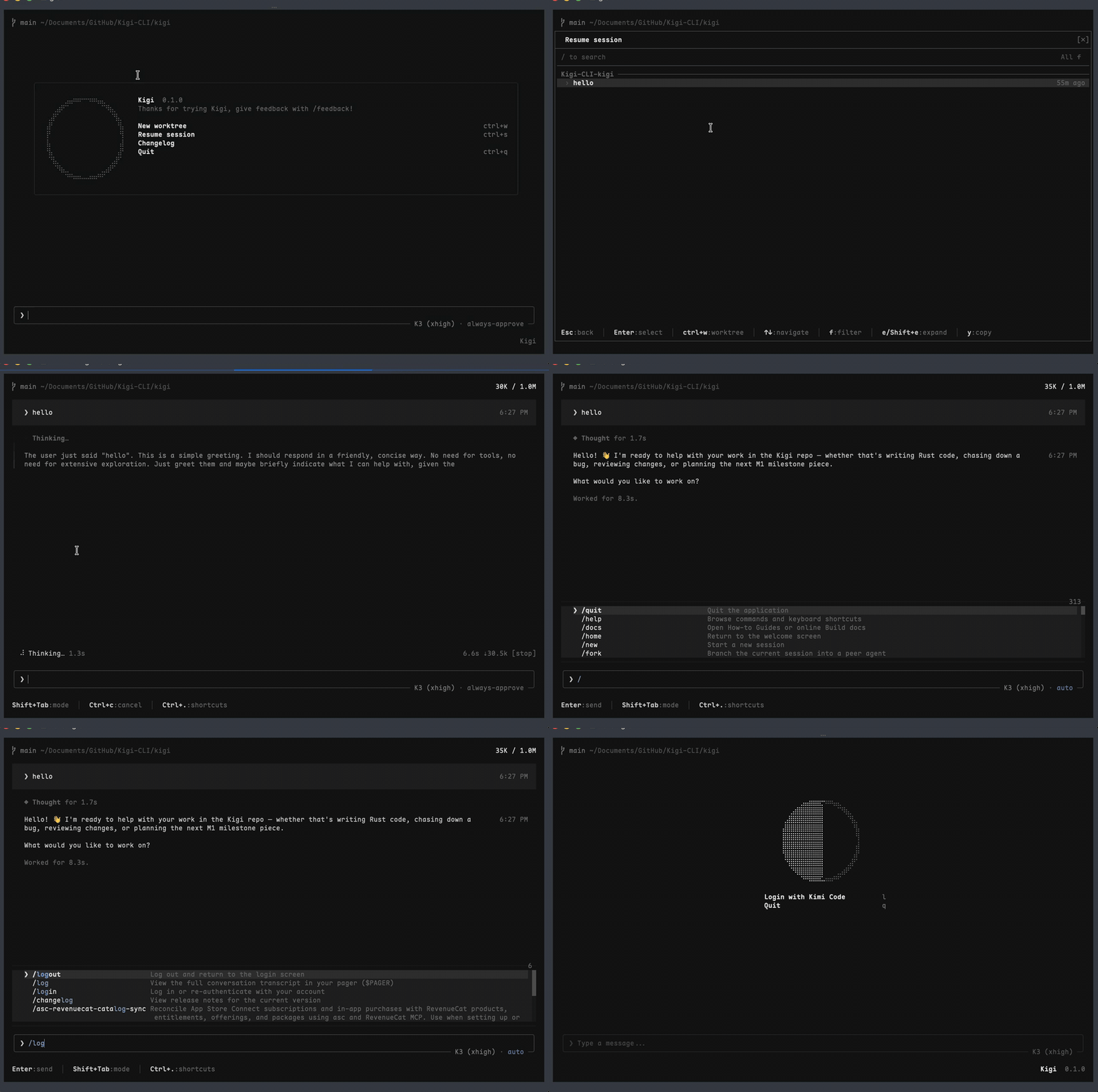
Kigi (kigi) 🌘

πŸ•ΈοΈ The world's first CLI with built-in Graph Engineering

/graph turns one objective into a dependency graph of autonomous, self-verifying agent loops β€” planned, parallelized, adversarially verified, and merged back, end to end.

**Kigi** is a coding agent that lives in your terminal. It reads the repo, writes the patch, runs the tests, and keeps going while you do something else. Full-screen, headless in CI with `-p`, or docked in your editor over ACP. **Already paying for Claude Pro/Max, ChatGPT Plus/Pro, GitHub Copilot, or Grok? Sign in and use it.** No API key, no second bill. Rather bring your own key? OpenAI, Anthropic, Google, DeepSeek, Groq, Moonshot and [two dozen more](#providers-and-api-keys) are wired in. [Installation](#installation) Β· [Graph engineering](#graph-engineering) Β· [Providers and API keys](#providers-and-api-keys) Β· [Building from source](#building-from-source) Β· [Coexistence with the official CLI](#coexistence-with-the-official-kimi-cli) Β· [License](#license) ![Kigi demo](video/Kigi.gif) [Full-quality recording (mp4)](video/Kigi.mp4)
--- ## Installation ```sh # macOS / Linux curl -fsSL https://raw.githubusercontent.com/ZacharyZhang-NY/Kigi-CLI/main/install.sh | bash ``` ```powershell # Windows PowerShell irm https://raw.githubusercontent.com/ZacharyZhang-NY/Kigi-CLI/main/install.ps1 | iex ``` ```sh kigi login # pick a provider, sign in kigi # go ``` Single file, no runtime. macOS and Linux on arm64/x86_64, Windows on x86_64, checksummed against the release's `SHA256SUMS`. `kigi update` handles upgrades. ## Graph engineering Every other agent runs a loop: think, act, repeat β€” one thread, one thing at a time. `/graph` runs a dependency graph instead. Work that doesn't block other work happens at the same time, in separate worktrees, and nothing merges until something else has tried to tear it apart. ``` /graph [--budget ] # decompose + run fully autonomously /graph status # node tree, budget, current work /graph show # box-drawing DAG view /graph pause | resume [--budget ] # halt / continue (budget top-up) /graph clear # abandon the graph ``` One command runs the whole thing, start to finish: - A planner breaks your objective into a dependency DAG, then validates it. - Independent nodes fan out as parallel workers, each in its own git worktree. - Every node has to get past an adversarial verifier before it merges back. - Find something out of scope? Say `DISCOVERED:` and the graph replans β€” append-only, so nothing already agreed on gets rewritten. - Between passes, a topology optimizer drops dependencies that were never real. - A final node re-checks the *whole* objective before the graph is allowed to call itself done. State lives in `.kigi/graph.jsonl`, next to your code. Close the laptop, come back tomorrow, `/graph resume`. A teammate can pick it up from the same file. On by default. `KIGI_GRAPH=0` turns it off; `KIGI_GRAPH_CONCURRENCY` (default 3) controls how many nodes run at once. ## Providers and API keys 29 platforms ship compiled in: 5 you sign into, 24 you hand a key. Nothing is registered at runtime β€” if it's not in this list, it's not there. **Sign in with a subscription you already pay for.** Run `kigi login` and pick. Each provider's token is stored under its own key, and one provider's credentials are never sent to another. | Platform id | Provider | Sign-in | | ---------------- | ------------------------- | ------------------------------------------- | | `kimi-code` | Kimi Code (original target)| Subscription OAuth (device code) | | `claude-pro-max` | Claude Pro/Max | Subscription OAuth (browser, PKCE) | | `openai-codex` | ChatGPT Plus/Pro (Codex) | Subscription OAuth (browser, PKCE) | | `github-copilot` | GitHub Copilot | Subscription OAuth (device code) | | `xai-grok` | xAI Grok | Subscription OAuth (device code) | You get whatever models your plan actually serves β€” the list is fetched at sign-in, not hardcoded. (ChatGPT/Codex is the exception: its backend publishes no model endpoint, so those four are compiled in.) **API-key providers.** Export the env var, or drop the key in `~/.kigi/config.toml`. Keys are never logged. | Provider | Platform id | API key env | | ------------------------- | ---------------------- | ----------------------------------------------- | | Moonshot (moonshot.cn) | `moonshot-cn` | `KIGI_MOONSHOT_CN_API_KEY` (or `KIGI_MOONSHOT_API_KEY`) | | Moonshot (moonshot.ai) | `moonshot-ai` | `KIGI_MOONSHOT_AI_API_KEY` (or `KIGI_MOONSHOT_API_KEY`) | | OpenAI | `openai` | `OPENAI_API_KEY` | | Anthropic | `anthropic` | `ANTHROPIC_API_KEY` | | DeepSeek | `deepseek` | `DEEPSEEK_API_KEY` | | Groq | `groq` | `GROQ_API_KEY` | | Mistral | `mistral` | `MISTRAL_API_KEY` | | Fireworks AI | `fireworks` | `FIREWORKS_API_KEY` | | Google Gemini | `google` | `GEMINI_API_KEY` | | OpenRouter | `openrouter` | `OPENROUTER_API_KEY` | | Together AI | `together` | `TOGETHER_API_KEY` | | Cerebras | `cerebras` | `CEREBRAS_API_KEY` | | NVIDIA NIM | `nvidia` | `NVIDIA_API_KEY` | | Vercel AI Gateway | `vercel-ai-gateway` | `AI_GATEWAY_API_KEY` | | xAI (Grok) | `xai` | `XAI_API_KEY` | | Qwen Token Plan | `qwen-token-plan` | `QWEN_TOKEN_PLAN_API_KEY` | | Qwen Token Plan (China) | `qwen-token-plan-cn` | `QWEN_TOKEN_PLAN_CN_API_KEY` | | Kimi For Coding | `kimi-coding` | `KIMI_API_KEY` | | Z.AI | `zai` | `ZAI_API_KEY` | | Z.AI Coding (China) | `zai-coding-cn` | `ZAI_CODING_CN_API_KEY` | | Xiaomi MiMo | `xiaomi` | `XIAOMI_API_KEY` | | Xiaomi Token Plan (China) | `xiaomi-token-plan-cn` | `XIAOMI_TOKEN_PLAN_CN_API_KEY` | | MiniMax | `minimax` | `MINIMAX_API_KEY` | | MiniMax (China) | `minimax-cn` | `MINIMAX_CN_API_KEY` | ```sh export OPENAI_API_KEY=sk-... export XAI_API_KEY=xai-... ``` ```toml # ~/.kigi/config.toml [platforms.openai] api_key = "sk-..." [platforms.xai] api_key = "xai-..." ``` Model lists sync on startup. Pick one with `/model`, set its thinking level with `/effort`. Web `search`/`fetch` need a Kimi Code subscription; API-key sessions run without them, same as the official client. ## Building from source ```sh rustup toolchain install 1.97.0 cargo build --profile release-dist -p kigi-bin ./target/release-dist/kigi --version ``` `protoc` is invoked through the vendored [dotslash](https://dotslash-cli.com) launcher at `bin/protoc`; install dotslash (`brew install dotslash` or `cargo install dotslash`) if it is not already on your PATH. ## Coexistence with the official Kimi CLI Kigi started as an unofficial Kimi Code CLI β€” a community fork of [xai-org/grok-build](https://github.com/xai-org/grok-build), not affiliated with Moonshot AI or xAI. It keeps its own binary, its own `~/.kigi`, its own keyring entry, and its own `KIGI_*` env vars, and never touches what the official `kimi` CLI installed. `kigi import-kimi` copies your old config over once, read-only. **Zero telemetry.** It talks to the APIs you configured, GitHub Releases, and your own MCP servers. Nothing else. ## License Apache-2.0. See [LICENSE](LICENSE), [NOTICE](NOTICE), and [THIRD-PARTY-NOTICES](THIRD-PARTY-NOTICES.md). Code ported from openai/codex and sst/opencode is documented in [crates/codegen/kigi-tools/THIRD_PARTY_NOTICES.md](crates/codegen/kigi-tools/THIRD_PARTY_NOTICES.md). Kigi is based on Grok Build Open Source; the `--version` output carries the attribution.